
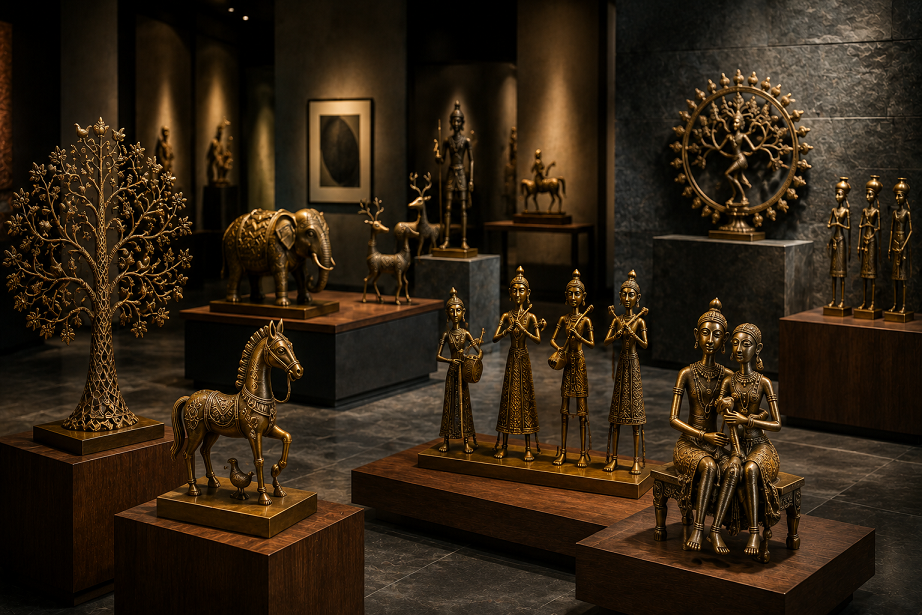
“Some works of art are created to decorate a space. Others preserve the memory of an entire civilization.”
Few art forms have survived thousands of years while remaining almost unchanged in their method of creation. Dhokra art is one of those extraordinary exceptions.
Believed to date back more than 4,000 years to the era of the Indus Valley Civilization, Dhokra is among India’s oldest surviving metal crafts. Even today, skilled tribal artisans continue to produce every sculpture using the ancient lost-wax casting technique—a painstaking process that transforms wax, clay, fire, and metal into timeless works of art.
At inSPARKart, we view every Dhokra creation not simply as décor but as a living expression of India’s cultural heritage, handcrafted for discerning collectors, interior designers, luxury retailers, and hospitality projects around the world.
A Legacy Forged Across Millennia
Archaeological discoveries from the Indus Valley Civilization, including the famous bronze “Dancing Girl” sculpture, demonstrate the remarkable sophistication of ancient Indian metal casting.
Although centuries have passed, many tribal communities across Bastar (Chhattisgarh), Bankura (West Bengal), Odisha, and Jharkhand continue to preserve these ancestral techniques with remarkable authenticity.
Each artisan learns the craft through years of observation and practice, passing knowledge from one generation to the next without relying on industrial machinery.
Every sculpture represents a tradition that has survived for thousands of years.
The Ancient Lost-Wax Process
Unlike mass-produced decorative items, no two Dhokra sculptures are ever identical.
Each piece begins with a handmade clay core carefully shaped by the artisan.
A layer of beeswax is then wrapped around the form and delicately decorated using fine wax threads to create intricate patterns and textures.
The completed wax model is coated with additional layers of clay before being fired in a traditional furnace.
As the wax melts away, it leaves behind a hollow cavity.
Molten brass or bronze is then poured into this space, permanently replacing the wax.
Once cooled, the outer clay mold is broken away to reveal a unique sculpture that can never be reproduced exactly.
Every piece is therefore an original work of art.
Symbolism Beyond Decoration
Dhokra sculptures often depict stories deeply connected to tribal life, nature, spirituality, music, and community.
Popular subjects include:
- Tribal musicians
- Dancing figures
- Mother and child sculptures
- Horses
- Elephants
- Bulls
- Deer
- Birds
- Village life
- Tree of Life motifs
- Folk deities
These themes reflect harmony between humanity and nature while celebrating everyday life through artistic expression.
Rather than following temporary design trends, Dhokra remains timeless because it tells universal stories.
Perfect for Contemporary Luxury Interiors
Today’s architects and interior designers increasingly combine heritage craftsmanship with contemporary spaces.
Dhokra art complements this philosophy beautifully.
Whether displayed in boutique hotels, luxury residences, executive offices, premium retail stores, or curated hospitality projects, handcrafted sculptures introduce warmth, authenticity, and cultural richness that machine-made décor cannot replicate.
The organic textures, earthy metallic finishes, and sculptural forms integrate naturally into modern minimalist interiors as well as traditional settings.
Sustainability Through Handcraft
Dhokra production reflects many principles associated with sustainable craftsmanship.
Most sculptures are individually handmade using traditional methods that rely on skilled manual labour rather than automated industrial production.
Because each sculpture is intended to last for generations, it represents an investment in enduring craftsmanship rather than disposable décor.
Supporting tribal artisans also helps preserve cultural heritage while creating sustainable livelihood opportunities within rural communities.
Growing Global Appreciation
Collectors, museums, luxury retailers, hospitality brands, and interior designers around the world increasingly seek authentic handmade art with cultural significance.
Dhokra sculptures satisfy this demand by offering originality, craftsmanship, and meaningful storytelling.
Unlike factory-produced decorative objects, every sculpture carries subtle variations that reflect the individual artisan’s creative hand.
This uniqueness significantly enhances both artistic and commercial value.
The inSPARKart Difference
At inSPARKart, our mission extends beyond exporting handcrafted products.
We strive to connect global buyers with India’s most remarkable artistic traditions through carefully curated collections that celebrate authenticity, craftsmanship, and responsible sourcing.
Each Dhokra sculpture is selected not only for its artistic excellence but also for its ability to represent India’s living heritage on the international stage.
Whether destined for a luxury residence in New York, a boutique hotel in Dubai, a gallery in Paris, or a designer showroom in London, every sculpture carries with it thousands of years of history shaped by skilled hands.
Preserving Heritage for Future Generations
In an age dominated by automation and mass production, Dhokra reminds us that true luxury often lies in patience, tradition, and human creativity.
Every handcrafted sculpture represents a dialogue between the past and the future—preserving ancient techniques while inspiring contemporary design.
When you choose authentic Dhokra art, you are not simply purchasing a decorative object.
You are preserving a legacy.
You are celebrating craftsmanship.
You are becoming part of a story that began over four millennia ago.
Discover timeless tribal artistry. Celebrate India’s living heritage. Experience authentic Dhokra craftsmanship with inSPARKart.